


Voltage optimisation · VoltSmart
VoltSmart: voltage optimisation, built into a smarter fuse board.
The mains voltage arriving at a lot of UK homes runs higher than your appliances actually need. VoltSmart replaces your existing fuse board with a smart consumer unit that trims that voltage to a steadier, lower level — quietly, with nothing for you to do — and modernises your electrical protection at the same time. It's a specific job that isn't right for every home. We measure your actual supply and tell you straight.
Fixed price · No same-day signature · Hertfordshire
What VoltSmart actually is
One board that optimises your voltage and modernises your electrics
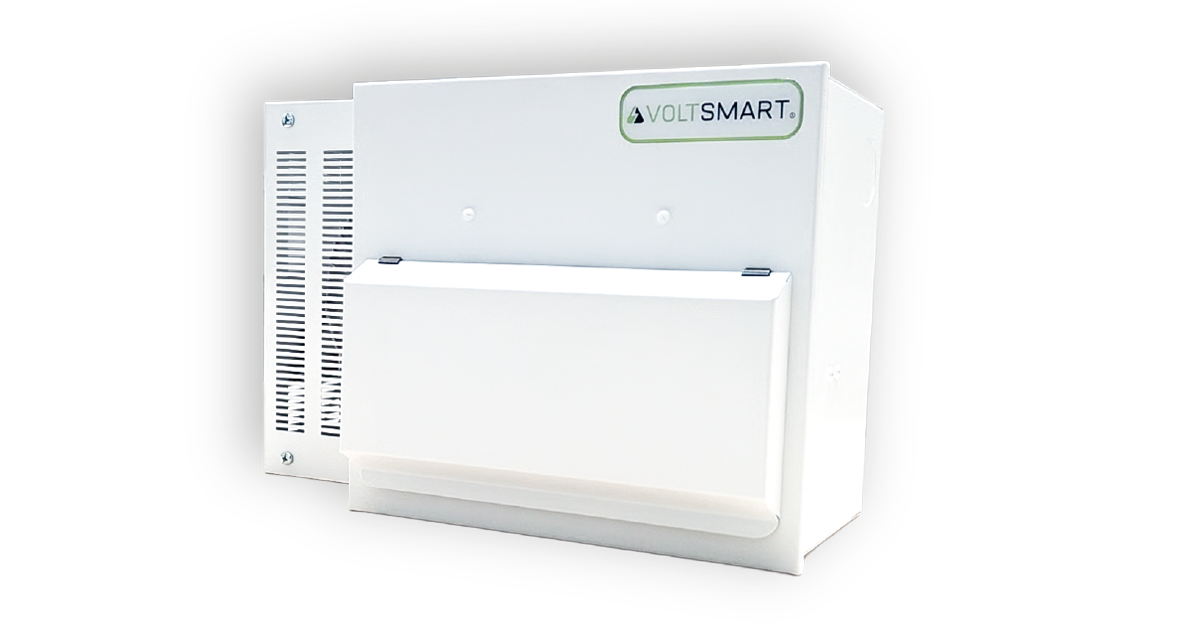
The grid doesn't deliver one flat voltage. It varies through the day and across the year, and in many UK homes it sits higher than appliances are designed around. VoltSmart fits in place of your existing fuse board — inside, auto-transformer technology trims that incoming voltage to a steadier, lower level before it reaches your sockets. Fit and forget: nothing changes about how you use your home.
Because it's also a modern consumer unit, you get today's protection in the same upgrade — RCBOs and dual-RCD options, surge protection, arc-fault detection and built-in fire-safety features. It comes in sizes from a compact 8-way up to 22-way to suit the property, and it sits happily alongside solar, a battery, an EV charger or a heat pump.
- Auto-transformer voltage optimisation — a steadier, lower supply
- Replaces your fuse board: RCBOs, dual-RCD options & surge protection
- Arc-fault detection and built-in fire-safety features
- 8-way to 22-way units, fitted by a qualified electrician
Let's be straight about savings
What VoltSmart claims — and how we check it's real for you
VoltSmart's own case studies report annual savings of roughly £187 to £490 and 153 to 820 kgCO₂e, depending on the property and how far its supply was running high. Those are VoltSmart's figures — and the real number for your home depends entirely on your incoming voltage and what you run. So we don't quote you a headline saving. We measure your actual supply first, and if there's little for VoltSmart to trim, we'll tell you it isn't worth fitting.
Alongside any saving, the part we'll always stand behind is the honest one: a steadier, lower supply is gentler on motors, compressors and electronics — and the board itself is a full modern-protection upgrade.
Is it worth it for you?
It suits some homes and does little for others
This is a specific fix, not a fit-and-forget upgrade for everyone. Here's the honest split.
More likely to suit you if…
Your incoming mains voltage measures high, and you run appliances with motors or compressors — fridges, freezers, pumps — that you'd like to be gentler on.
Probably not worth it if…
Your supply already sits close to the nominal level, or most of your load is simple resistive heating. In that case there's little for an optimiser to do, and we'll say so.
How we decide
We look at your actual incoming voltage and what you run, rather than assume. No measurement, no recommendation — we won't fit one just because it's on the price list.
How we do it
Done properly, and itemised in full
If it's right for your home, you see exactly what you're paying for — no vague bundle price.
- A check of your incoming voltage and the load in your home before we recommend anything
- A plain answer on whether VoltSmart is worth fitting for you
- The right VoltSmart unit for your supply and board size (8-way to 22-way)
- A fixed, itemised quote that doesn't move once issued
- Installation in place of your existing fuse board, by a qualified electrician
- Modern protection in the same job — RCBOs, surge and arc-fault detection
- It fits naturally alongside solar, battery, an EV charger or a heat pump
Start with your own home
Not sure if it's worth it? We'll give you a straight answer
Book a free analysis and we'll look at your real setup — voltage optimisation included — and tell you honestly whether it's worth doing. If it isn't, we'll say so.
Get your free analysisFrom the blog
Straight talk on home energy
Why we start with your half-hourly data, not your annual bill
Your annual kWh hides the one thing that decides what system you actually need: the shape of how you use power.
28 July 2026 · 4 min read BatteriesIs a home battery actually worth it? The honest answer
For some homes a battery is the piece that makes everything add up. For others the sums are thinner. Here's how to tell which you are.
21 July 2026 · 5 min read Heat pumpsHeat pump myths, and what's actually true
“They don't work in cold weather.” “You need underfloor heating.” “They're always cheaper to run.” Let's sort the myths from the facts.
14 July 2026 · 6 min readStart with your own numbers